
Add custom AI agents to your marketing team with Agent Cloud



Enterprise marketers have no shortage of AI tools. What they often lack is a reliable way to carry intelligence through an entire workflow.
Each team may have excellent AI technology at their disposal, yet the connections between them still depend on exported files, copied data, meeting recaps, and people consistently remembering to pass along the right information.
The tools themselves get faster. The handoffs remain sluggish. That distinction helps explain why substantial AI investment can coexist with tons of operational friction. Improving individual tasks does not automatically improve the system those tasks belong to.
And when every transition introduces a small loss of context, even AI-forward organizations experience something familiar: death by a thousand handoffs.
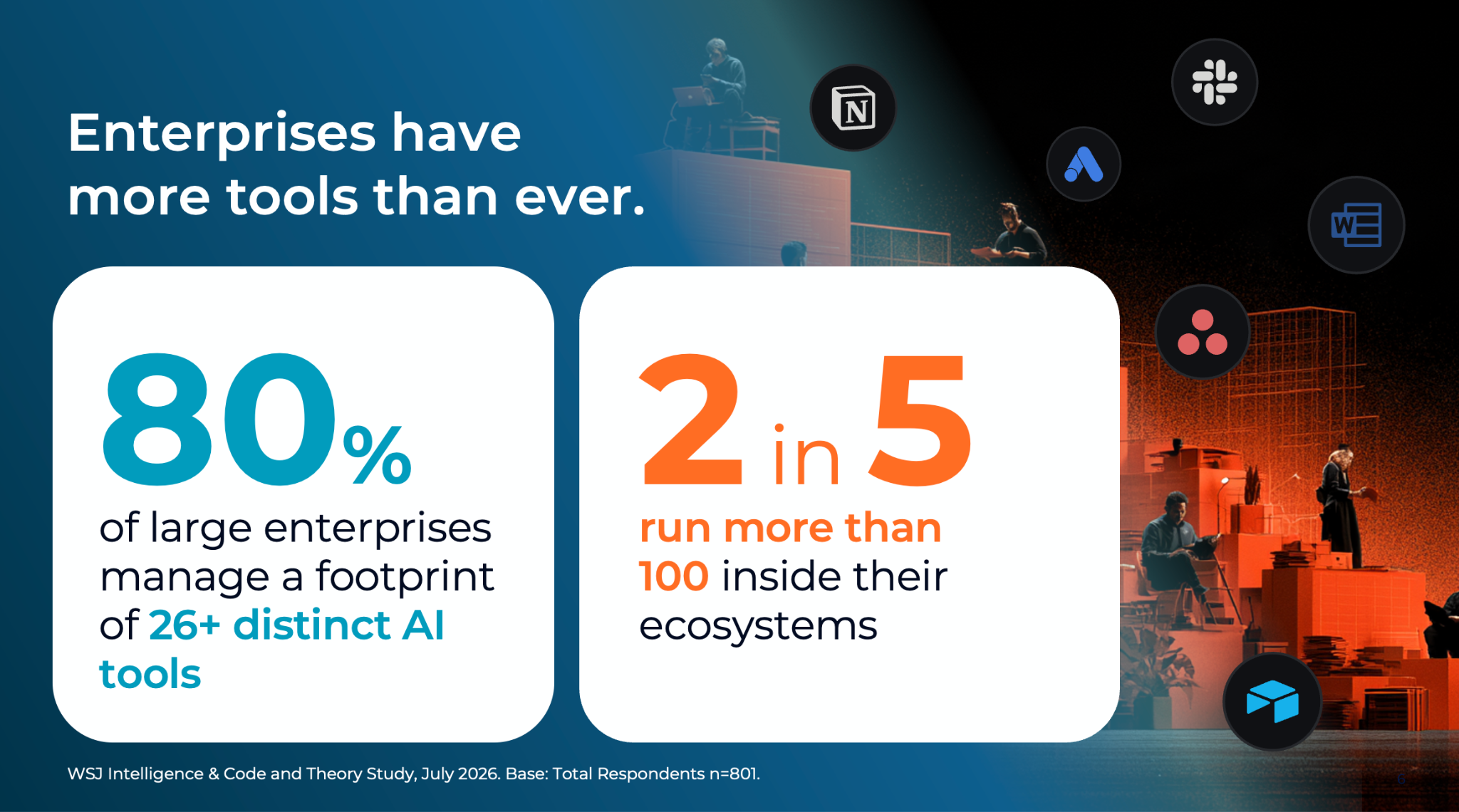
Research from WSJ Intelligence and Code and Theory, conducted in 2026 among 801 cross-functional C-suite executives, puts the scale of this challenge into perspective. 80% of large enterprises manage 26 or more distinct AI tools. Two in five operate more than 100 within their ecosystems.
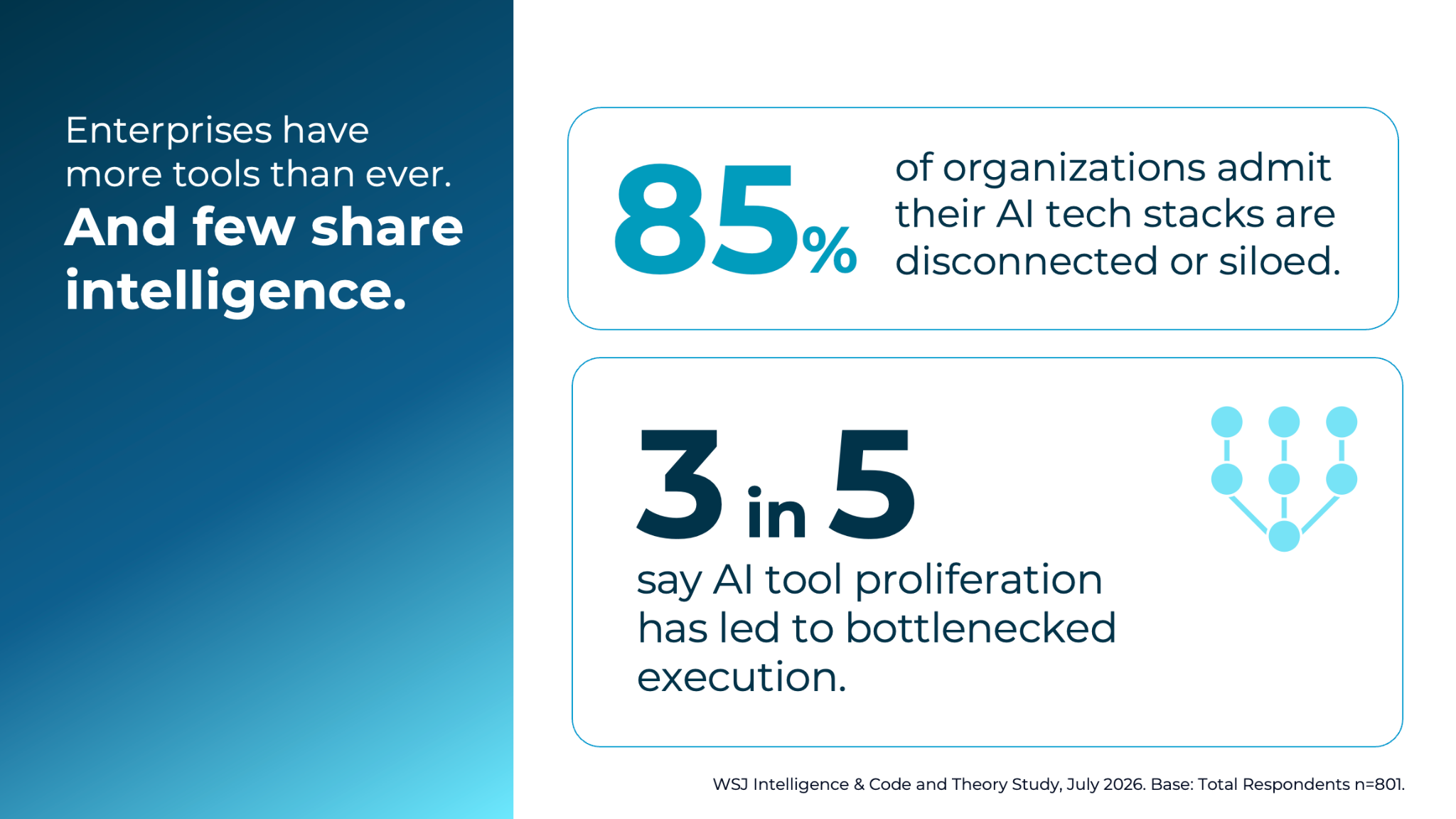
Yet 85% of organizations say their AI technology stacks are disconnected or siloed; three in five say AI tool proliferation has led to bottlenecked execution.
Taken together, those findings challenge the assumption that adding capabilities necessarily removes constraints.
Enterprises are not simply struggling to adopt AI. They are struggling to make a growing collection of capabilities and solutions function as a connected way of working.
Each additional AI platform or tool can solve a legitimate problem—while simultaneously introducing another place where information must be transferred, interpreted, or reconciled. The cost is not confined to software budgets (which certainly can add up), but . iIt appears in duplicated effort, slower decisions, and work that barrels on without the full benefit of organizational knowledge.
It’s very likely that a given AI tool makes its individual user more productive—but not as likely that do those gains survive the next handoff.
Marketing depends on more than deliverables. It depends on the reasoning and insights that produced them.
But those elements (and the data points behind them) rarely live together. The supporting evidence may sit in a research platform, the offline discussion that shaped the decision may exist only in a meeting transcript, and relevant creative may be stored in a corner of SharePoint where the next team would never think to look.
When work moves forward without that context, people fill in the gaps. They repeat research, revisit settled questions, or make decisions using incomplete information. It’s redundant, a little maddening, and a drain on productivity.
None of these moments necessarily looks like a major failure: a clarification sync here, a rebuilt brief there. Across an enterprise, however, small inefficiencies accumulate and snowball.
AI can accelerate the production of individual outputs without resolving this underlying problem. More output is not the same as more shared understanding.
The next stage of enterprise AI requires better orchestration in order to connect people, tools, and data.
This is not simply a matter of moving files between platforms seamlessly, or having a top-notch Digital Asset Management system. A document can arrive successfully while the reasoning behind it disappears.
Effective orchestration allows the next team to understand what has already been learned, which decisions have been made, and where judgment is still needed. Research informs creative, audience intelligence informs activation, and campaign results become inputs for subsequent decisions rather than remaining isolated in a reporting system.
The appetite for this approach is clear. In the same research, 94% of respondents agreed that better orchestration of people and tools would help grow their business.
Leaders clearly recognize the limits of disconnected adoption. The challenge is translating that recognition into the way work gets designed.
At Stagwell, our approach starts with the work practitioners actually need to accomplish.
We draw on 12,000 marketing practitioners and relationships with 5,000 clients to inform how we build technology. That perspective matters because enterprise marketing problems rarely fit neatly within the boundaries of one tool or team.
This is the thinking behind Stagwell Machines—our name for the family of agentic solutions tailored to enterprise marketing organizations.[GK3] Each “machine” is built for a specific job, connected under a shared operating layer, with the aim of carrying signals, decisions, and results forward.
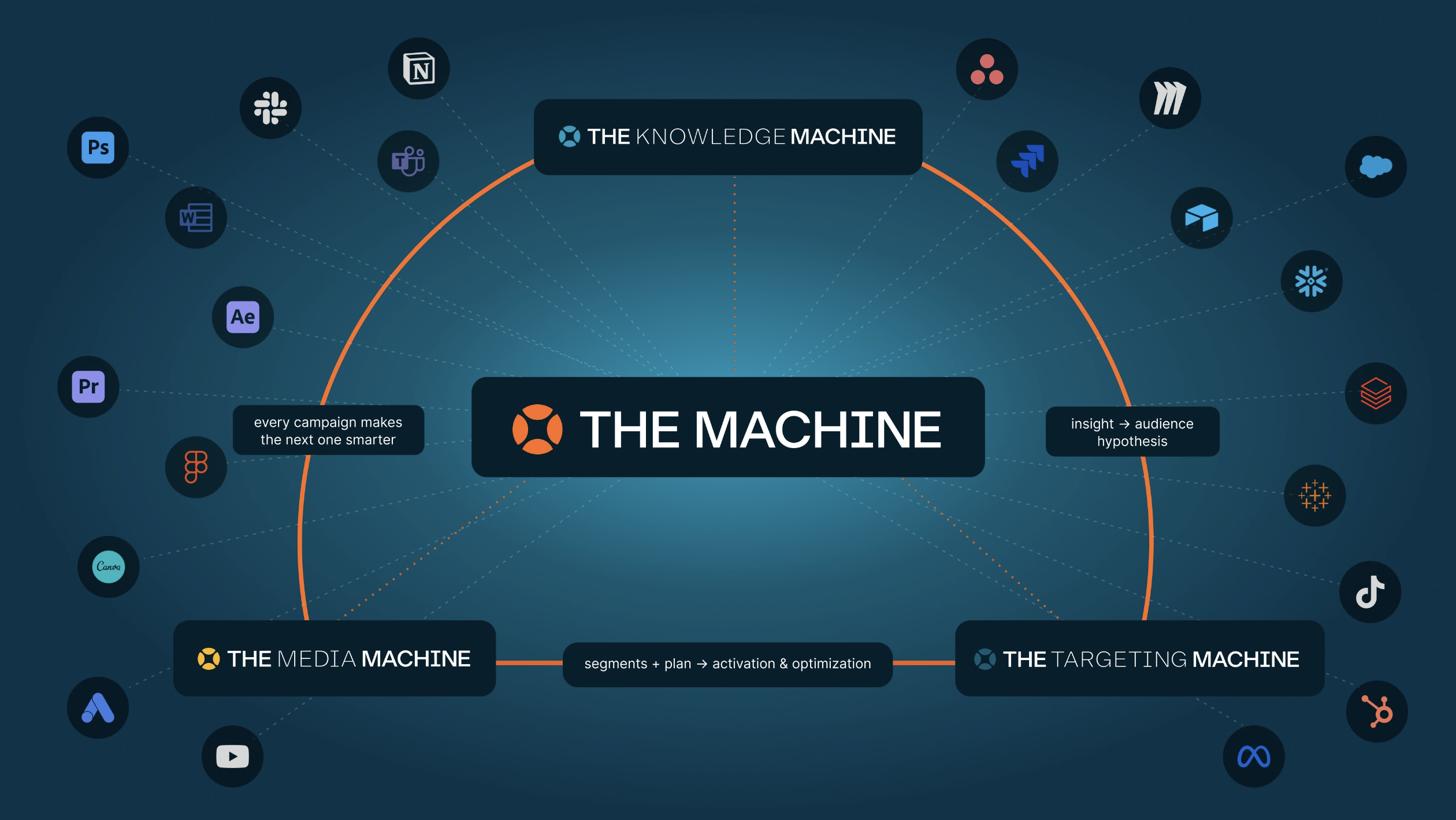
For communications leaders, The Knowledge Machine tracks emotional signals across news and social channels into strategic intelligence, using historical patterns to help anticipate narrative momentum.
For strategy leaders, The Targeting Machine connects fragmented first-party data with proprietary intelligence from sources including BERA.ai and The Harris Poll. Its foundation includes the Stagwell ID Graph, spanning 260 million U.S. consumers and 123 million households, to support audience development using behavioral and attitudinal signals.
And for media leaders, the focus extends beyond planning into cross-platform activation and optimization, from campaign creation to ongoing investment reallocation, while keeping humans in control of critical decisions.
The scale of the underlying data matters. So does its usefulness to the next decision. The objective is not simply to assemble more intelligence, but to make it available where work happens.
For leaders evaluating their own organizations, a practical starting point is to QA one workflow from research through activation.
Where must someone explain the same decision twice? Where is information manually copied between systems? Where does a team receive a recommendation without access to its supporting evidence? Where do campaign results stop informing future work?
Those questions reveal problems that a software inventory cannot.
They also suggest more useful measures of progress in the midst of AI adoption: less repeated work, fewer manual transfers, and less time spent reconstructing context. Organizations should establish their own baselines and KPIs and test whether changes improve those outcomes.
The goal is not to eliminate collaboration or automate every decision—sometimes having that additional sync or quick meeting to clarify a point can lead to its own eureka moment. But better orchestration means that your people aren’t stepping in to compensate for the redundancies, missteps, and inefficiencies of disconnected AI solutions.
Powerful tools are an important beginning, but simply collecting the shiniest ones isn’t a recipe for cross-team success. Organizational transformation depends on what happens between these tools, and how much intelligence survives the workflow’s journey.
This piece was adapted from a keynote address delivered at the ANA AI and Technology For Marketers conference on September 23, 2026.
