Add custom AI agents to your marketing team with Agent Cloud



Good news: All seems quiet for your brand after a rough news cycle. Sentiment scores have barely moved, and most social mentions are positive or neutral.
Seems like a decent time to let your VP of Comms take that overdue three-week vacation.
But inside this apparently stable picture of brand health, something could be brewing.
Customers who were mildly disappointed are becoming distrustful. And a small but motivated audience is beginning to air those feelings in forums.
Sentiment analysis remains useful here. But 360-degree reputation intelligence requires more than knowing whether people approve or disapprove. It requires understanding what is actually driving their response, and what that means for your brand.
Sentiment analysis helps organizations classify and interpret commentary (positive, negative, neutral) at a scale no communications team can manage manually.
Taking a more granular approach, aspect-based sentiment analysis separate reactions to particular attributes. For instance, customers might have positive sentiments about a product’s performance, and negative sentiments about its price.
Sentiment analysis tools offer genuine value. They help teams organize feedback, investigate emerging complaints, compare responses, and decide where to look more closely.
But if comms teams stop there, they risk responding to an incomplete picture.
Consider two hypothetical comments about a healthcare brand that just released a pricey new GLP-1 treatment:
“I’m worried I won’t be able to afford this treatment.”
“They know people need this treatment, and they’re exploiting us.”
Both could be classified as negative. Yet the first expresses anxiety about access. The second response is driven by vulnerability and concerns over fairness.
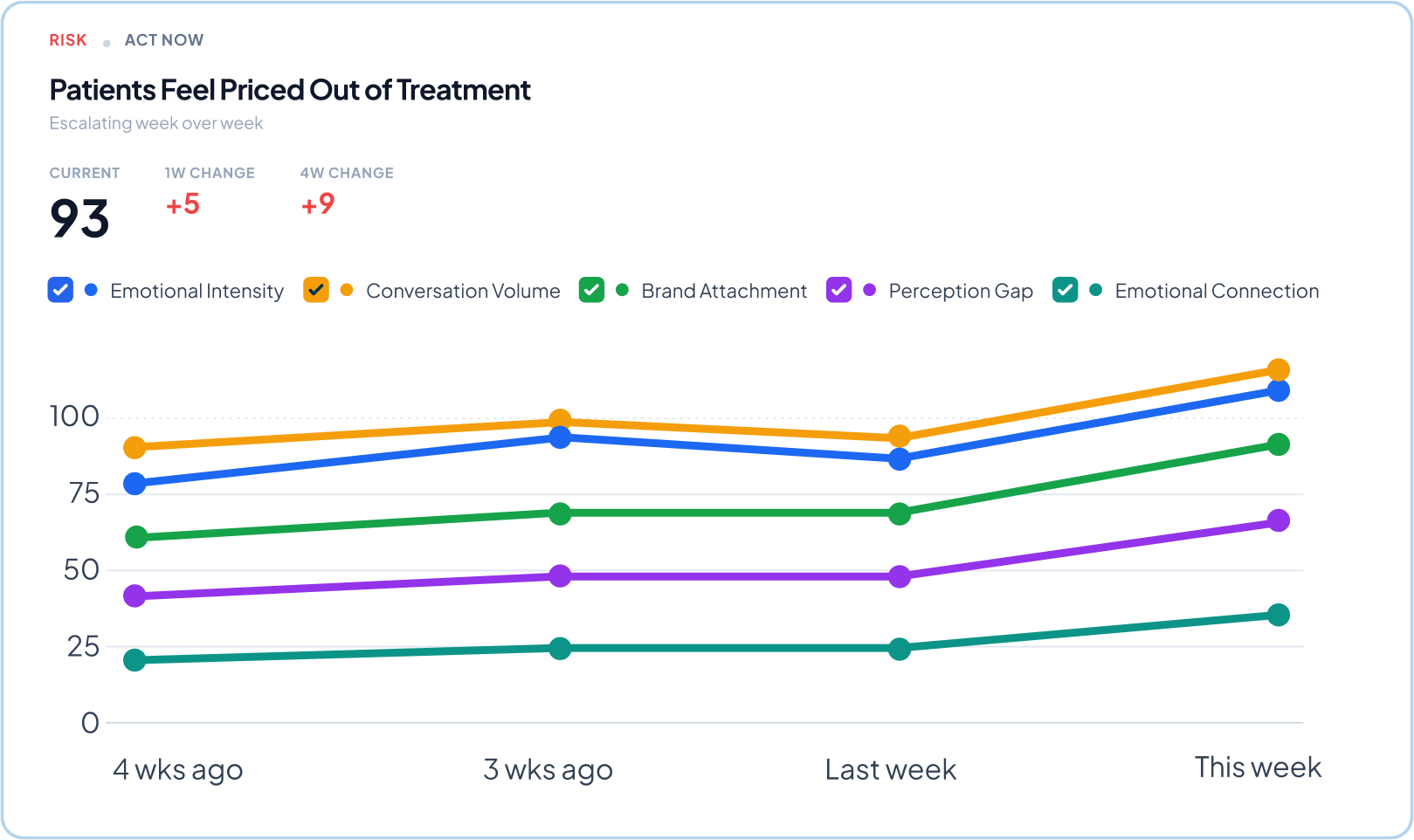
Those two negative sentiments, while similar on a surface level, call for different responses. Practical information about financial assistance may help someone navigating uncertainty. But this same tactic may come across as evasive to someone demanding accountability for perceived unfairness.
Even a perfectly accurate ‘negative’ sentiment label leaves a ton of open questions.
What is the audience reacting to? What belief connects individual complaints? Is the brand being criticized for an operational failure, or becoming a symbol of a larger grievance?
Without those answers, communications teams can rush to respond to the visible topic, while missing the underlying concern.
Let’s return to the two hypothetical consumer comments above regarding a new GLP-1 treatment. Sentiment analytics sees two negatives. Emotional analytics sees two very different people.
The first comment (“I’m worried I won’t be able to afford this treatment”) reads as anxiety: this person wants the treatment and is worried they can't get it.
The second (“They know people need this treatment, and they’re exploiting us”) is driven by concerns over fairness: this person believes the company is taking advantage of patients.
Layered on top of the sentiment score, those emotions tell you who you're actually talking to and what they need to hear.
As a result, this allows for more nuanced planning, tailored for individual audiences. For example:
Same topic, same negative score, two different messages. A single "negative" label would have sent both groups the same response, likely alienating a large percentage of the audience.
One big caveat here: Emotional analytics works best when it's paired with human judgment. An emotion label is an educated read on an observable signal, not a window into someone's head (AI, despite all its advances, is still not telepathic). Your team's audience knowledge and review are what turn the read into the right call.
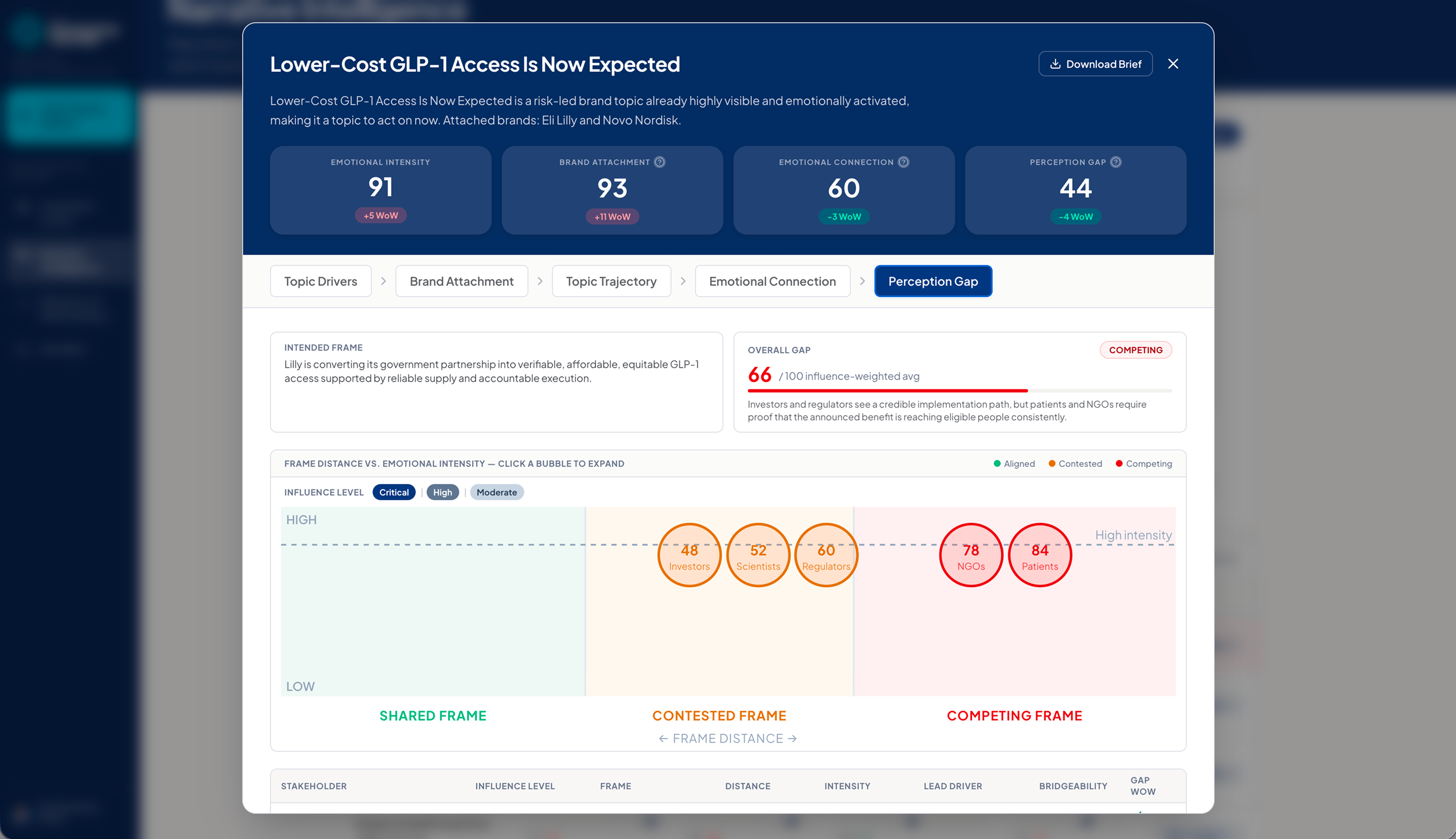
A brand’s reputation doesn’t develop in isolation. People interpret what a company says and does through their experiences, their expectations of its industry, and the larger pressures shaping their lives.
The Knowledge Machine, our newly launched decision-intelligence platform, untangles those complexities using what we call a ‘Society–Industry–Brand’ framework. Rather than treating every negative mention as a standalone ‘brand’ problem, this approach peels back three connected layers:
Society: The broader conditions shaping public expectations. Concerns about affordability, distrust of institutions, or a diminishing sense of personal control can influence how people interpret a company’s actions—perhaps by casting your GLP-1 brand as a profit-hungry villain, rather than the creators of a life-changing innovation.
Industry: How those pressures translate into expectations of a particular sector. In healthcare, for example, affordability concerns can become demands for accessible treatment, transparent pricing, and evidence that innovation benefits patients.
Brand: Where those expectations meet an organization’s actual messages and behavior. Is the company demonstrating that it understands patient concerns about the cost of its new GLP-1 treatment? Or are they simply touting its medical benefits while ignoring how financially inaccessible it is to many consumers?
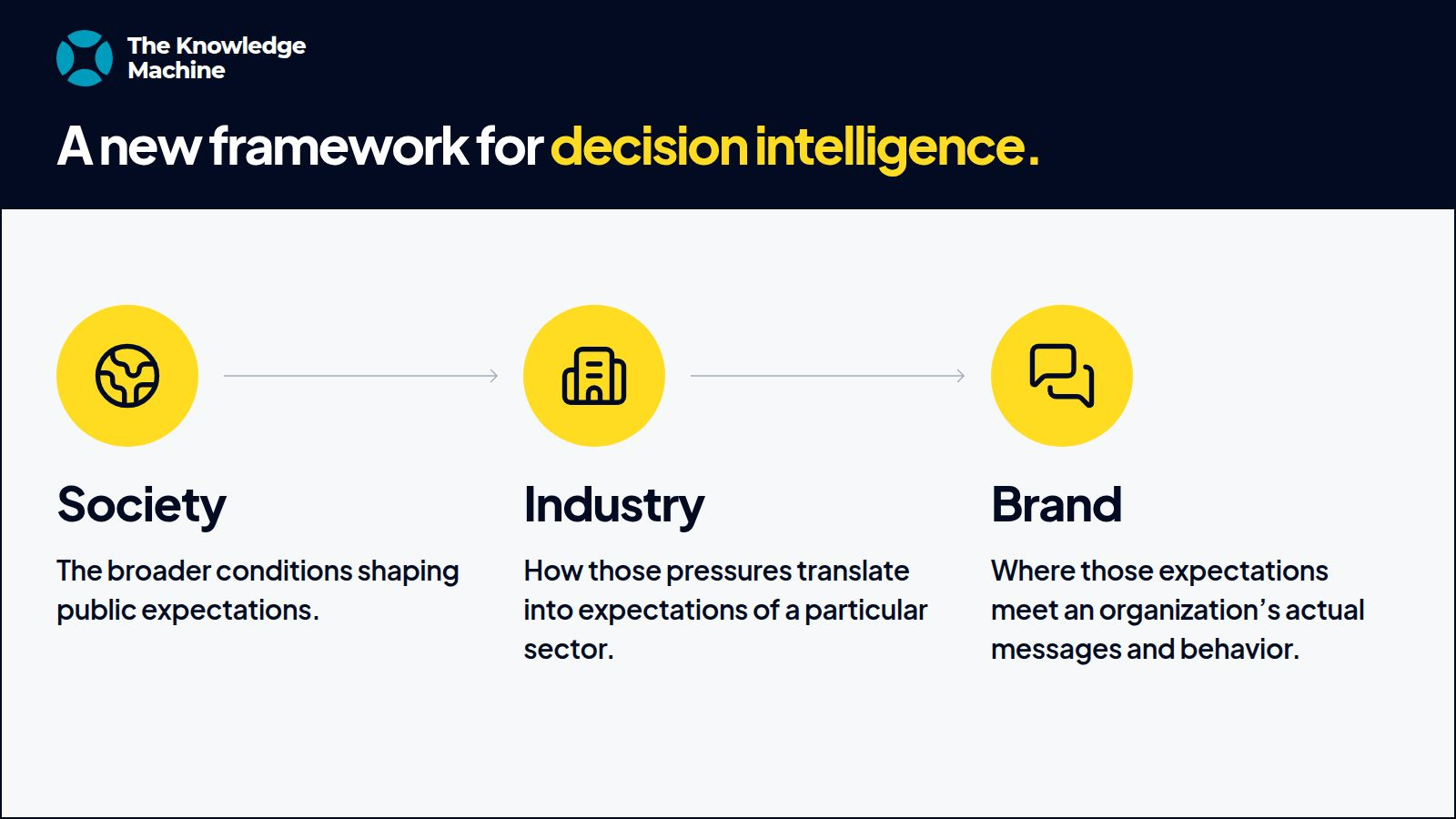
The framework connects these layers to identify gaps between a brand’s priorities and the expectations against which it is being judged.
Now, a savvv comms manager has specific levers to pull before an issue snowballs into a crisis. Returning to our treatment roll-out, this might mean:
Consider that hypothetical healthcare company with a stunningly effective new GLP-1 treatment. The narratives around this expensive product are around affordability, access, innovation, and trust.
The healthcare brand might emphasize the treatment’s scientific promise while audiences are actually looking for proof that they can obtain and afford it. In that situation, repeating the ‘innovation’ message more forcefully may not address the concern (and might actually make things worse). The comms task here is to explain—and substantiate—patient access and benefit.
But the analysis doesn’t end there. Emotional signals add another essential distinction: are people confused about access, anxious about their options, or angry about perceived unfairness? The topic may be the same, but the response should not be.
The larger opportunity for decision intelligence goes beyond reporting how people feel about a brand via standard sentiment analysis. Newer analytics built into The Knowledge Machine help understand the expectations behind those sentiments, and identify what the organization needs to do differently in its response.
Sentiment analysis and emotional analysis are complementary, and neither of these approaches succeeds in isolation. But working in tandem, they paint a fuller picture of your audience’s needs, desires, and discontents.
So tell your overworked VP of Comms to book that vacation. With sentiment and emotional analytics working together, you’ll know whether “all quiet” actually means all quiet.