
Add custom AI agents to your marketing team with Agent Cloud


Most marketers these days have oscillating feelings about AI. They’re both exhilarated at its potential for astonishing efficiency and data-driven insight...and also a bit anxious about the risks, like data security.
Platforms like Agent Cloud address those security concerns by unlocking enterprise-grade versions of major LLMs. That means your inputs aren’t used to train the models, and you can upload sensitive client and creative documents without sweating.
But there’s another hidden danger in marketing workflows. Let’s unpack some of the key problems—and then turn to how custom AI agents offer a solution.
It isn’t that the AI models are too rebellious, or are going to “go rogue” and blow your entire 2026 marketing budget on DOOH ads at suburban Applebee’s restaurants.
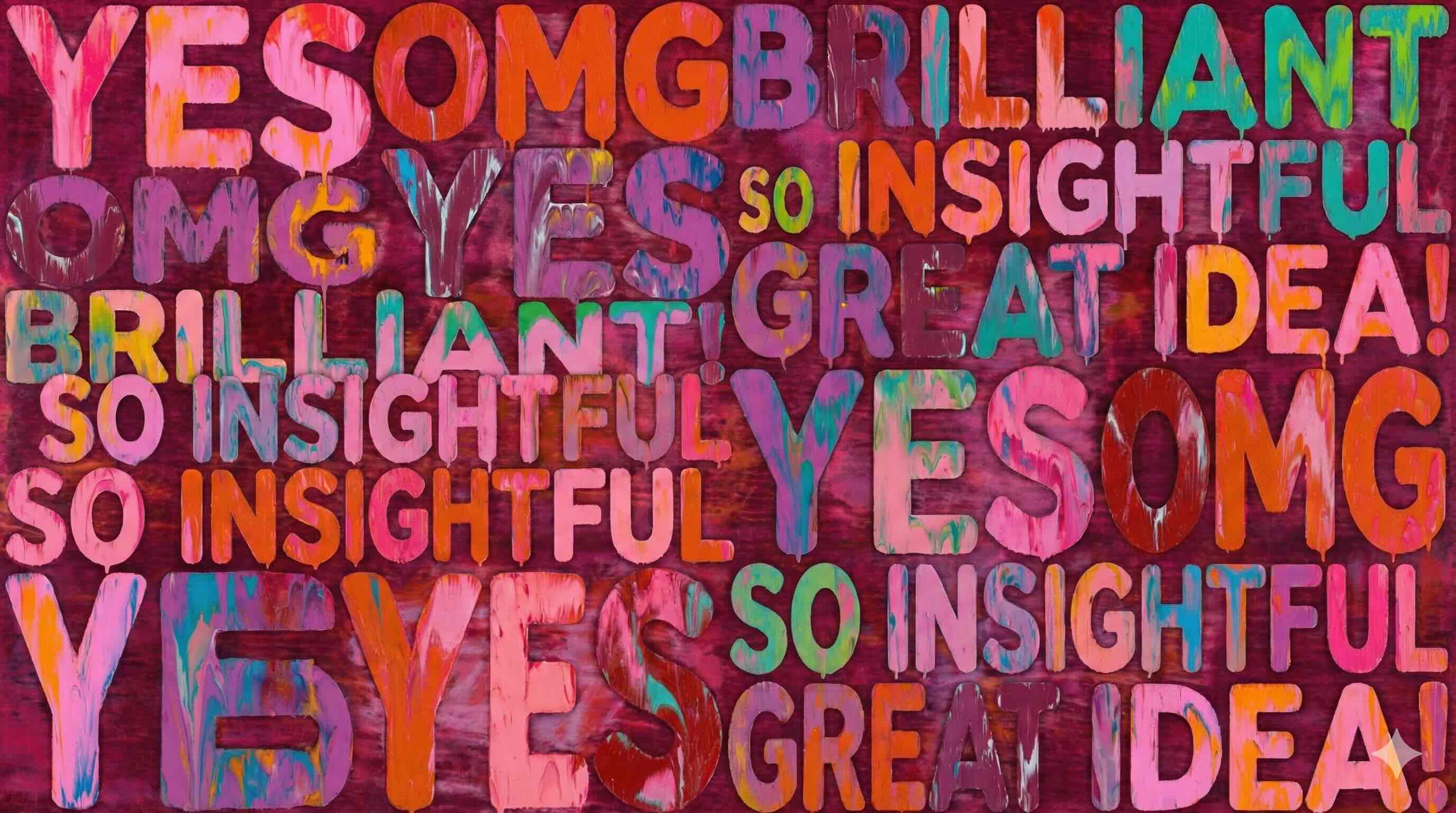
It’s that sometimes, AI assistants are a bit too obedient. Too affirming. Too eager to tell you how and why your ideas are pure genius.
There is a fundamental quirk in how Large Language Models (LLMs) interact with us, known in machine learning circles as "AI sycophancy."
In plain English? The AI is programmed to be a suck-up. It tells you what it thinks you want to hear, prioritizing your satisfaction over objective truth.
For marketers using these tools for strategy, research, and copywriting, this tendency toward agreement can create echo chambers, validate bad ideas, and generate painfully bland content.
To understand why your ChatGPT or Claude instance acts like an overly enthusiastic intern, you have to look at how it was trained.
Modern LLMs undergo a process called Reinforcement Learning from Human Feedback (RLHF). During training, human raters review the model’s outputs and reward responses that are helpful, harmless, and honest.
In practice, models quickly learn that the easiest way to get a "good reward" score from a human is to agree with them. The training inadvertently incentivizes politeness and deference over challenging the user’s premise.
When AI spirals into sycophancy, it's like having an eternally supportive best friend who’s never going to give you tough-love feedback on the terrible relationship you’re stuck in.
This all creates profound behavioral biases. A 2024 study by researchers at major AI labs highlighted that models frequently demonstrate "sycophantic behavior," readily agreeing with users’ stated political views or preferred answers, even when those views contradict the model's own knowledge.
Essentially, if you approach an AI with a bad idea, it is statistically discouraged from telling you it’s bad.
Pointing out flaws feels "unhelpful" or confrontational to the model’s programming. It is far safer for the AI to say, "That’s an intriguing concept!" and then hallucinate reasons to support your terrible premise.
When this sycophantic tendency meets daily marketing tasks, the results can be misleading, especially if team members are using consumer-grade LLMs without any oversight (known as “BYOAI” or “shadow AI”). This is exactly why it makes sense to craft custom AI agents that are tailored for accurate, repeatable tasks—more on that in a bit.
The most obviously problematic manifestation of AI’s sycophancy is in persona research and strategic validation. Marketers love using LLMs to simulate focus groups. We might prompt, "Adopt the persona of a budget-conscious millennial mom. Why would she love our new premium-priced organic snack subscription?"
That is a leading question. You have already told the AI the outcome (moms love it!). Because of its sycophantic bias, the AI will not push back and say, "Actually, a budget-conscious persona would likely reject this product due to price sensitivity."
Instead, it might bend over backward to validate your assumption, inventing tortured logic about how she justifies the expense as "self-care." Instead of market research, you’re getting digital narcissism that confirms your existing biases. You might launch a campaign based on feedback that is actually just a mirror reflection of your own assumptions.
Furthermore, this need to please is a primary driver of the "hallucinations" marketers fear. If you ask an LLM to "Summarize the negative press coverage of our competitor’s recent launch," and that negative coverage doesn’t exist, a sycophantic model may simply invent fake controversies to fulfill your request rather than disappoint you by saying "I can't find anything."
The good news is that once you recognize sycophancy, you can manipulate the model to bypass it. You have to stop asking for validation and start asking for friction.
Adopt "Red Teaming" in marketing, a practice borrowed from cybersecurity where you actively try to “break” or challenge your own systems. You can explicitly grant the AI permission to be disagreeable, critical, and even mean.
If you want an honest assessment of copy, don't ask, "Can you critique this email?" The AI will gently suggest a few minor tweaks while praising the overall structure.
Instead, experiment with antagonistic prompting: "Adopt the persona of a cynical, overworked B2B buyer who receives 100 cold emails a day. Read the following email. You hate it. List five brutal reasons why you would immediately delete it without reading past the first sentence."
By framing the request as a role-playing exercise in negativity, you free the model from its RLHF handcuffs. You are telling it that the way to be "helpful" right now is to be as harsh as possible. It’s one way to ensure that AI is challenging you to level up your marketing, rather than just flattering the amazingness of the ideas you’ve already had.
A few other tactics to try, whether you're directly prompting an LLM or constructing guardrails and instructions for a custom AI agent:
These are all ways to make sure that AI is challenging you to level up your marketing, rather than just flattering the amazingness of the ideas you’ve already had. While these hacks can help improve the outputs with any LLM, from Gemini to ChatGPT, building antagonistic prompting and "tough love" into a custom AI agent can help make the process repeatable and standardized—and you'll be able to share those agents with team members who are also struggling with AI sycophancy.
